
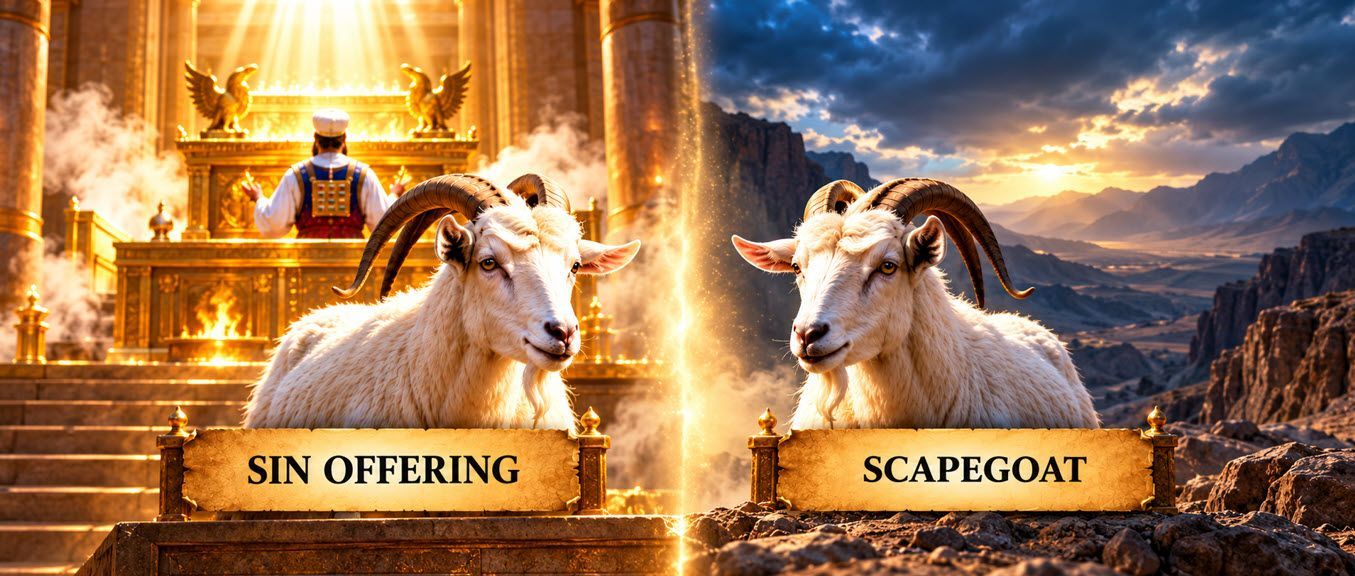
Does Leviticus 16 prove that the scapegoat participated in Christ's work of atonement? Or have Christians misunderstood the distinct roles of the two goats?
One of the most debated questions surrounding the Day of Atonement concerns the identity and purpose of the scapegoat.
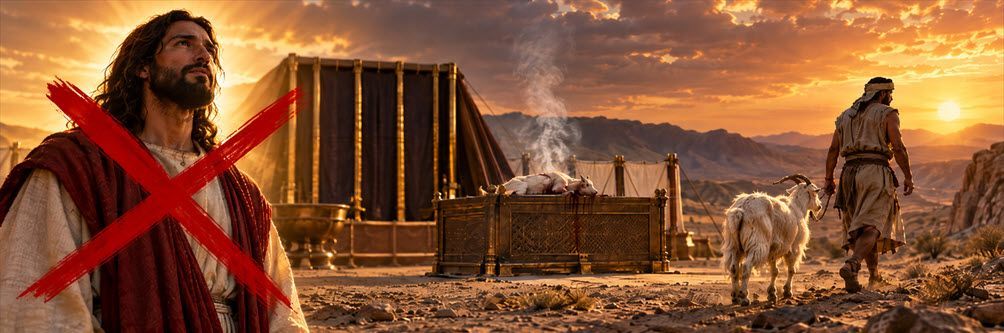
Many Christians believe that both goats in Leviticus 16 represented Jesus Christ. According to this interpretation, the Lord's goat and the scapegoat performed complementary functions within one work of atonement.
But does the biblical account support the conclusion that both goats cooperated in making the same sacrificial atonement? As Seventh-day Adventists, we have traditionally understood the Lord's goat to represent Jesus Christ and the scapegoat, or Azazel, to represent Satan. However, a passage frequently raised against this interpretation is Leviticus 16:10.
Does Leviticus 16:10 Teach a Joint Atonement?
Consider what Leviticus 16:9–10 says in the King James Version:
"And Aaron shall bring the goat upon which the LORD'S lot fell, and offer him for a sin offering. But the goat, on which the lot fell to be the scapegoat, shall be presented alive before the LORD, to make an atonement with him, and to let him go for a scapegoat into the wilderness."
Notice the expression "to make an atonement WITH HIM."
At first glance, this sounds like the living goat participated in making atonement alongside another party.
- Some might interpret this as the scapegoat making atonement with the Lord's goat.
- Others could view the expression as describing an atoning action performed with the high priest or before the Lord.
If either of these views is correct, it would confirm that the scapegoat did make an atonement and directly point to Christ, "by whom we have now received the atonement" (Romans 5:11). Be that as it may, let's examine the text to determine what is really being stated.


What Does "With Him" Mean in Hebrew?
The expression translated "to make an atonement with him" is:
לְכַפֵּר עָלָיו — Lekhapper ʿalav
The verb kaphar concerns making atonement, which in the sanctuary context includes purification and the restoration of a proper relationship with God.
The word ʿalav comes from the Hebrew preposition ʿal, which has several possible meanings depending on its context. These include "upon," "over," "on," "against," and "for."
Consequently, the expression in Leviticus 16:10 does not necessarily mean two individuals are working together.
This distinction becomes clearer when we compare several Bible translations.
- The English Standard Version (ESV) and New Revised Standard Version (NRSV) use the expression "atonement OVER it."
- The New King James Version (NKJV), New American Standard Bible 1995 (NASB), and Legacy Standard Bible translate the expression as making atonement "UPON it."
- The Amplified Bible uses "atonement ON it."
The above translations all make the claim that the atonement wasn't made WITH the scapegoat; the atonement was made UPON the scapegoat. We know this is the correct interpretation because, according to Leviticus 16:20, the reconciliation for the sanctuary was completed before the sins were confessed upon the scapegoat. Let's examine this a little closer.
The Sanctuary Was Cleansed Before the Scapegoat Received the Sins
To understand the distinction between the Lord's goat and the scapegoat, we must examine the order of the Day of Atonement ceremony.
- Leviticus 16:5 tells us that two goats were selected from the congregation for a sin offering.
- Lots were cast, assigning one goat to the Lord and the other to Azazel.
- The Lord's goat was sacrificed, and its blood was taken into the sanctuary.
- Leviticus 16:15–16 explains that the blood was used to make atonement for the holy place because of the uncleanness and transgressions of Israel. The blood of the sin offering was central to the purification of the sanctuary.
But when did the scapegoat enter the ceremonial sequence? Notice Leviticus 16:20:
"And when he hath made an end of reconciling the holy place, and the tabernacle of the congregation, and the altar, he shall bring the live goat."
The word translated "reconciling" comes from the same Hebrew verb, kaphar, used for making atonement.
In other words, the high priest completed the atonement for the sanctuary, the tabernacle, and the altar BEFORE bringing forward the living goat.
This does not mean that every ritual of the entire Day of Atonement had concluded, since additional ceremonies follow in the chapter. But it does establish something significant: The sanctuary's blood purification was completed without the sacrifice, blood, or death of the scapegoat.
Thus, the atonement could not have been made WITH the scapegoat; the atonement had to have been made UPON the scapegoat.
But Didn't Jesus Bear Our Sins?
Another objection to the Adventist interpretation concerns the bearing of sins. A close analysis of Leviticus 16 reveals that the sins weren't transferred to the sin offering during the ceremony. Now, this does not mean the sin offering did not bear the sins of the people; however, Biblically speaking, we do not see that part of the ceremony drawn out in the chapter. The only time we see the sins being transferred was onto the scapegoat. Therefore, when we read Isaiah 53:12, which tells us that the Messiah "...bare the sin of many." And likewise, when Hebrews 9:28 declares: "So Christ was once offered to bear the sins of many," it seems logical that when Christ bore our sins, He bore them as the scapegoat.
However, what many are forgetting is that Christ's crucifixion was also typified by the Daily services. Thus, the bearing of sin was not limited to the Day of Atonement.
The Daily Sanctuary Service Also Involved Bearing Sin
The Day of Atonement was not the only sanctuary ceremony that pointed forward to Jesus Christ. The daily sanctuary services also involved sin offerings, priestly mediation, and atonement. Consider Leviticus 10:17:
"Wherefore have ye not eaten the sin offering in the holy place, seeing it is most holy, and God hath given it you to bear the iniquity of the congregation, to make an atonement for them before the LORD?"
Notice that the passage explicitly connects the priests with bearing the iniquity of the congregation. Although the precise relationship between eating the offering and bearing iniquity is debated among biblical scholars, the passage demonstrates that bearing iniquity was not language reserved exclusively for the scapegoat. The priestly ministry also involved bearing responsibility in connection with Israel's sins.
This is important because Jesus Christ fulfills more than one aspect of the sanctuary service. He is both our sacrifice and our heavenly High Priest. His atoning death and His priestly ministry must therefore be considered together when interpreting the symbolism of the sanctuary.
Both the Daily Sacrifices and the Day of Atonement Pointed to Christ
Hebrews 7:27 declares:
"Who needeth not daily, as those high priests, to offer up sacrifice, first for his own sins, and then for the people's: for this he did once, when he offered up himself."
Now, you should be able to see that Jesus' death was typified by the Day of Atonement and the Daily Services at the same time. Thus, when Isaiah says He bare the sin of many, we correlate that bearing with the daily services rather than the scapegoat on the Day of Atonement.
Conclusion: One Ceremony, Two Distinct Functions
So, did the Lord's goat and the scapegoat work together to accomplish one sacrificial atonement? No. The Lord's goat was sacrificed, and its blood purified the sanctuary. However, only after that purification was completed did the high priest bring forward the living goat, confess Israel's iniquities upon it, and send it away into the wilderness.
And when we examine the Hebrew expression in Leviticus 16:10, we discover that the phrase translated "make an atonement WITH HIM" does not necessarily describe two participants cooperating in the same sacrifice. Several Bible translations appropriately render the expression as making atonement "upon" or "over" the goat. But the decisive evidence comes from the fact that the atonement was made before the scapegoat had the sins confessed over it. Thus, both animals had prescribed roles in the Day of Atonement, but they did not perform identical functions.
For Seventh-day Adventists, this distinction is fundamental to understanding why the Lord's goat represents Jesus Christ while the scapegoat represents Satan. Christ is our sacrifice, our mediator, and our heavenly High Priest. And His saving work is entirely sufficient.