
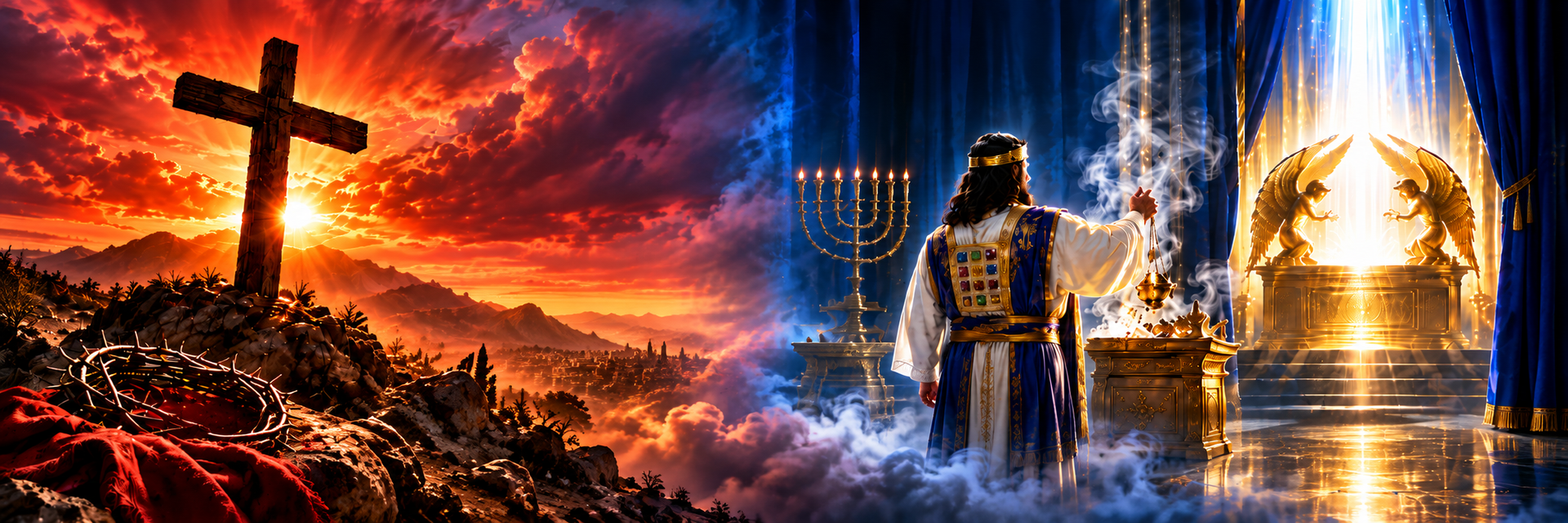
Few ceremonies in the Old Testament are as mysterious—or as controversial—as the Day of Atonement described in Leviticus 16.
At the center of that ceremony were two goats. Lots were cast over them: one was designated “for the LORD,” while the other was designated “for Azazel,” traditionally translated into English as “the scapegoat.”
The goat for the LORD was killed as the people’s sin offering. Its blood was carried into the sanctuary and used in the work of cleansing and atonement. Only after that sanctuary ministry was completed did the high priest approach the living goat, place both hands upon its head, confess over it all the iniquities, transgressions, and sins of Israel, and have it led away into the wilderness by a fit man.
But who did that living goat represent? There are two major interpretations.
Many Christians believe the scapegoat represents Jesus Christ. Seventh-day Adventists, however, have historically understood Azazel to represent Satan. Because of this, the Adventist interpretation has often been attacked as heretical.
However, before dismissing either position, we should acknowledge why many Christians identify the scapegoat with Christ.
When we look at the work of the scapegoat, we see that the sins of Israel were confessed over the it. The goat was said to bear their iniquities. And it carried those sins away into the wilderness. Those ideas naturally remind Christians of passages such as Isaiah 53 and 1 Peter 2, which describe Christ bearing our sins. In this manner we recognize that the Christ-is-the-scapegoat interpretation is logical.
But when we look at the entire Day of Atonement ceremony, rather than a few isolated similarities, I believe a different picture begins to emerge. And in order to illustrate this picture to you, I will present them to you as five reasons the scapegoat cannot be Jesus.
1. “Scapegoat” Can Be a Misleading Translation
The first problem begins with the word scapegoat itself. The Hebrew term in Leviticus 16 is Azazel. In our modern Western vernacular, a scapegoat is a person who is unfairly blamed for the wrongdoing of someone else. And if that definition is placed over Leviticus 16, Jesus immediately comes to mind. Christ was innocent, yet He suffered for the guilty.
However, that modern meaning is not what the Hebrew word Azazel meant. Historically, scholars parsed Azazel into two words:
עֵז — ʿēz = goat
אָזַל — ʾāzal = to go/go away
עֲזָאזֵל — ʿăzāʾzēl = “goat that goes away” / “departing goat”
As you can see, Azazel was at one point connected with the idea of a goat going away or departing. Over time, the idea of the "departed goat" slowly became the “goat that escapes.” Unfortunately, that misapplication continued to evolve, and the "escaped goat" became known as the scapegoat. Yet when we read the account of Azazel's work in Leviticus 16, it is evident that the live goat never escaped. It is clear that the scapegoat was deliberately removed from the camp and sent into the wilderness. N
That changes the question.
Instead of asking: Who was unfairly blamed for someone else’s sins, we should be asking: Who is ultimately removed, banished, or exiled?
That question points the discussion in a very different direction.
2. Early Jewish LITERATURE INTERPRETed Azazel as a Fallen Angel
Another common criticism is that Seventh-day Adventists invented the idea that Azazel represents Satan. But the association of Azazel with an evil supernatural being existed long before the Adventist Church.
Ancient Jewish literature contains traditions in which Azazel is associated with a fallen angel or demonic figure. Here are a few examples:
Thou seest what Azazel hath done, who hath taught all unrighteousness on earth and revealed the eternal secrets which were (preserved) in heaven. The Book of Enoch, chapter 9
And again the Lord said to Raphael: 'Bind Azazel hand and foot, and cast him into the darkness: and make an opening in the desert, which is in Dudael, and cast him therein. And place upon him rough and jagged rocks, and cover him with darkness, and let him abide there for ever, and cover his face that he may not see light. And on the day of the great judgement he shall be cast into the fire. The Book of Enoch, chapter 10
Azaz’el and the angels wh[o came to the daughters of man] (8) [and s]ired themselves giants. And concerning ‘Azaz’el [is written …] (9) [to love] injustice and to let him inherit evil for all [his] ag[e …] A fragment from Qumran, 4Q180 (Pesher on the Periods) p. 164
I said to the angel: “What is this, my lord?” And he said: “This is ungodliness, this is Azazel.” And he said to it: “Disgrace upon thee, Azazel! For Abraham’s lot is in heaven, but thine upon the earth. Because thou hast chosen and loved this for the dwelling-(place) of thine uncleanness, therefore the eternal mighty Lord made thee a dweller upon the earth and through thee every evil spirit of lies, and through thee wrath and trials for the generations of ungodly men. Apocalypse of Abraham 13 (vs. 7-10)
While our doctrines are not based upon extra-biblical Jewish literature, you should be able to see that in ancient times, Azazel wasn't interpreted as the Messiah, he was interpreted as a fallen angel.
This historical evidence is important because it demonstrates that interpreting Azazel as an evil supernatural personality is not a uniquely Adventist invention.
Long before Seventh-day Adventism existed, Jewish interpreters were already associating Azazel with the realm of fallen spiritual beings.
3. Azazel Is Contrasted With the LORD
Perhaps one of the simplest observations in the entire passage is also one of the most important. Leviticus 16:8 says:
“And Aaron shall cast lots upon the two goats; one lot for the LORD, and the other lot for the scapegoat.”
In the Hebrew structure, we have essentially:
one lot for YHWH
and
one lot for Azazel
That juxtaposition should not be ignored.
Notice, the text does not say that one goat represented one aspect of the LORD and another goat represented another aspect of the LORD.
Instead, the goats receive two distinct designations.
One is for the LORD.
The other is for Azazel.
Throughout Scripture, we often see opposing persons or allegiances presented in parallel. For example:
- Elijah contrasted the gods of Baal with the LORD.
- Paul contrasted Christ with Belial.
- Jesus contrasted serving God with serving mammon.
None of these passages individually proves the identity of Azazel. But they establish an important biblical pattern: when Scripture places two opposing designations beside one another, we should not casually assume that they represent the same person. Only one of the goats in Leviticus 16 was explicitly designated “for the LORD.”
And that goat was the one that died as the sin offering.
4. The Scapegoat Was Never Sacrificed
Christianity centers upon the sacrifice of Jesus Christ.
Jesus said:
“Greater love hath no man than this, that a man lay down his life for his friends.”
John 3:16 tells us that God gave His only begotten Son.
Christ died for us.
That is why the goat for the LORD so naturally points to Christ:
“Then shall he kill the goat of the sin offering…”
The goat for the LORD dies.
Its blood is shed.
Its blood is carried into the sanctuary.
Its blood is involved in the work of atonement and cleansing.
But the goat for Azazel is treated completely differently.
It is never sacrificed.
It remains alive.
Some interpreters answer that the two goats together represent two aspects of Christ’s saving work.
It is true that Scripture sometimes uses more than one animal in a single symbolic ceremony.
But that still leaves an important question:
If the purpose were simply to portray one complete sacrifice of Christ, why was a second living goat necessary at all?
The sin offering could have been sacrificed, its blood used in the sanctuary, and its body afterward taken away.
But that is not what God instructed Israel to do.
Instead, He deliberately introduced another goat.
That second goat does not die.
It performs a different function.
And it enters the ceremony at a different time.
Which leads us to what I believe is the strongest argument of all.
5. The Order of the Service Does Not Fit Christ
The sequence of the Day of Atonement matters.
The sanctuary was not merely a collection of disconnected ceremonies. Its services revealed the progression of God’s plan of redemption.
And when we compare the type with the New Testament fulfillment, there is a remarkable sequence.
The sacrifice is selected.
Sin is dealt with.
The sacrifice dies.
The priest enters the sanctuary with blood.
The sanctuary is cleansed.
The priest completes his sanctuary ministry.
Then comes the live goat.
The transcript develops the sequence this way: Christ was appointed as the sacrifice; He bore our sins; He died for our sins; He entered the heavenly sanctuary by His own blood; and the heavenly ministry reaches its cleansing/judgment culmination. Only after the sanctuary work is completed does the Azazel goat become the focus of the Leviticus 16 ceremony.
And that creates a serious problem if Azazel represents Christ.
Leviticus 16:20–21 places the live goat after the sanctuary ministry has been completed.
Only then are the sins placed upon its head.
Only then is it led into the wilderness.
So if the scapegoat represents Jesus, the typological sequence would ultimately require Christ to bear the sins in the role of Azazel after the atoning sanctuary work has already reached its conclusion—and then Christ would be the one who is banished.
That does not fit the biblical picture of the Second Coming.
Christ does not return from the heavenly sanctuary in order to be driven into exile.
He returns as King, Deliverer, and Savior.
Someone else is removed.
Someone else is separated from the redeemed.
Someone else is ultimately confined after Christ completes His work.
And that someone is Satan.
The Two Goats Were Sequential, Not Simultaneous
This distinction cannot be overstated.
The goat for the LORD and the goat for Azazel do not perform their functions simultaneously.
While the goat for the LORD is being sacrificed and its blood is ministered in the sanctuary, the Azazel goat is not performing its final role.
Only after the sanctuary has been dealt with does the high priest return to the living goat.
In other words:
The LORD’s goat:
Sacrifice → blood → sanctuary → atonement/cleansing
Azazel:
Sins placed upon it afterward → removal → wilderness
The two goats have separate functions at separate stages of the service.
That is why simply saying, “Both goats bear sin, therefore both represent Christ,” does not settle the question.
We have to ask when they bear sin, how they bear sin, and what happens afterward.
So Who Does the Scapegoat Represent?
When all five points are brought together, the picture becomes much clearer.
The traditional English term scapegoat can obscure the meaning of Azazel.
Ancient Jewish sources associated Azazel with a fallen supernatural being.
Azazel is explicitly contrasted with the goat “for the LORD.”
The Azazel goat is never sacrificed.
And most importantly, Azazel performs its final function after the sanctuary ministry has been completed.
Taken together, these points lead Seventh-day Adventists to conclude that the scapegoat represents Satan rather than Christ.
Christ alone provides the sacrifice.
Christ alone provides the blood.
Christ alone accomplishes our redemption.
Azazel enters the picture afterward.
But Important Questions Remain
Of course, this study does not answer every objection.
If Azazel represents Satan, several major questions immediately arise:
Why was the goat treated as part of the Day of Atonement ceremony?
What does it mean for the sins of Israel to be placed upon Azazel?
And perhaps most importantly:
Did Azazel combine with the LORD’s goat to make a sin offering?
That is the question we will examine next.
The scapegoat controversy cannot be settled by one English word or one isolated verse. We must allow the entire sanctuary service, its sequence, and its symbolism to tell the story.
The Adventist Watchman
Suggested website excerpt
Who does the scapegoat of Leviticus 16 represent—Jesus Christ or Satan? Examine five reasons the Day of Atonement ceremony points away from Christ and toward Satan as Azazel.
Suggested SEO title
5 Reasons the Scapegoat Can’t Be Jesus | Azazel in Leviticus 16
Suggested meta description
Does the scapegoat in Leviticus 16 represent Jesus or Satan? Examine five biblical reasons Seventh-day Adventists identify Azazel with Satan, including the two lots, sacrifice, and the order of the Day of Atonement.
While Adventists also believe in the substitutionary nature of Christ's atonement, we do not believe in the Penal substitutionary atonement as commonly taught by many Evangelicals. One of the reasons for this is that PSA is commonly framed in a manner that suggests God punished Christ with our punishment. While this may sound like a strange position to take, there are a few texts that seem to support this view. One popular text is Isaiah 53:4, which says,
"Surely he hath borne our griefs, and carried our sorrows: yet we did esteem him stricken, smitten of God, and afflicted."
If we are to take this text at face value without any further context, we would have to agree that God literally smote Christ. However, Adventists understand that when God allows something to come to pass, He is often portrayed as doing it. We see a perfect example of this in Job 13:15:
"Though he slay me, yet will I trust in him: but I will maintain mine own ways before him."
If you're familiar with this story, you know that God was not the One who slayed Job; it was actually Satan. However, Job's account of his trials and tribulations portrayed God as performing the punishment He allowed. With this full context, we can see that God didn't literally smite Christ, but rather He allowed Christ to be smitten.
The second and biggest reason Adventists don't adhere to the way PSA is commonly taught is based upon how penal is viewed. Penal is a legal word for punishment. Thus, proponents of PSA see the atonement as being fully complete when Jesus suffered the penalty on the cross.
Here are a few texts that are used to confirm this view:
Romans 3:25 says, "Whom God hath set forth to be a propitiation through faith in his blood, to declare his righteousness for the remission of sins that are past, through the forbearance of God."
Hebrews 10:10 says, "By the which will we are sanctified through the offering of the body of Jesus Christ once for all."
John 19:30 says, "When Jesus therefore had received the vinegar, he said, It is finished."
Due to the interpretation of the aforementioned texts, along with many others, supporters of PSA confine the atonement solely to the cross.
However, because Adventists don't agree with all the tenets of PSA, we are often accused of not believing in the finished work of Christ. Nonetheless, this assertion is completely false. Notice how Ellen White dispels this false narrative:
"Man broke the law. Christ came to this earth to make an atonement for transgression. His atonement was complete in every part. As He hung on the cross, He could say, “It is finished.” The demands of justice were satisfied. The way to the throne of grace was opened for every sinner." ST July 31, 1901
As you can see, Adventists do teach that Christ's atonement was complete at the cross; however, we also believe that Christ continued His atonement in the heavenly sanctuary.
If we were to simplify the difference between Penal Substitutionary Atonement as commonly taught by Evangelicals vs. the Substitutionary Atonement as commonly taught by Adventists, we would say that mainstream Christians teach a front-loaded atonement centered around the cross, and Adventist Christians believe in a phased atonement that encompasses Christ's sacrifice and Priesthood.
Atonement in three phases
The sanctuary had three primary areas:
- The Courtyard
- The Holy Place
- The Most Holy Place
As Adventists, we should understand that an atoning ministry can be seen in connection with all three areas. Let's examine this theory a little further:
Atonement in the Courtyard
Leviticus 1:4 says concerning the burnt offering:
“And he shall put his hand upon the head of the burnt offering; and it shall be accepted for him to make atonement for him.”
The sacrifice took place in the courtyard. The victim died as a substitute for the sinner. This points unmistakably to Jesus Christ, who gave Himself for us at Calvary.
However, it must also be understood that even though Christ’s sacrifice was complete, the earthly sanctuary service did not end when the animal died.
Atonement in the Holy Place
Leviticus 6:30 makes an important statement:
“And no sin offering, whereof any of the blood is brought into the tabernacle of the congregation to reconcile withal in the holy place, shall be eaten…”
Other translations render this as blood being brought into the sanctuary “to make atonement in the Holy Place.”
Notice what has happened. The sacrifice has already died. Yet the priest takes the blood produced by that completed sacrifice and ministers it inside the sanctuary.
And Scripture still calls this atonement.
That means the death of the sacrifice did not terminate everything the Bible describes as atoning ministry. The sacrifice provided the blood. The priest then ministered that blood.
Atonement in the Most Holy Place
Once each year came the great Day of Atonement.
Leviticus 23:27–28 says:
“Also on the tenth day of this seventh month there shall be a day of atonement…”
On this day, the high priest entered the Most Holy Place. Leviticus 16:33 gives a remarkable summary:
“And he shall make an atonement for the holy sanctuary, and he shall make an atonement for the tabernacle of the congregation, and for the altar, and he shall make an atonement for the priests, and for all the people of the congregation.”
The entire sanctuary system came together in this annual service.
Atonement involved:
- the altar,
- the sanctuary,
- the priesthood,
- and the people.
1Chronicles 6:49 provides a similar summary of Aaron’s ministry:
“But Aaron and his sons offered upon the altar of the burnt offering, and on the altar of incense, and were appointed for all the work of the place most holy, and to make an atonement for Israel…”
The courtyard altar, the altar of incense, and the work of the Most Holy Place were all brought together in one description of the priestly ministry. Thus, the atonement was not front-loaded at the moment the offering was sacrificed; the atonement was phased throughout the sacrificial service.
The Sacrifice Was Finished—But the High Priest Still Ministers
John 19:30 says, "When Jesus therefore had received the vinegar, he said, It is finished: and he bowed his head, and gave up the ghost."
But notice what Revelation 16:17 says:
"...and there came a great voice out of the temple of heaven, from the throne, saying, It is done."
We should be able to see that when Jesus' sacrificial atonement was complete, He said, "It is finished." However, we should also see that when Christ's sanctuary atonement was complete, God said, "It is done."
It should be understood that Adventists are not denying Christ's sacrificial atonement. His sacrifice was complete. However, we also recognize the Savior's continuing atoning work in the heavenly sanctuary.
What is Christ's atoning work in the heavenly sanctuary? Hebrews 2:17 reveals this when it says,
"Wherefore in all things it behoved him to be made like unto his brethren, that he might be a merciful and faithful high priest in things pertaining to God, to make reconciliation for the sins of the people."
Notice, this reconciliation for the sins of the people began after Christ resurrected as our High Priest. This does not negate His work on the cross; it simply reveals that another phase of atonement continued in the sanctuary.
So the question is not: Was Christ’s sacrifice complete? The question is: Did His completed sacrifice eliminate the need for His subsequent work as our High Priest? The Bible’s answer is no. Jesus is both our Sacrifice and our High Priest. Calvary provided the blood upon which His heavenly ministry is based.
Hebrews 7:25 reveals this when it says:
“Wherefore he is able also to save them to the uttermost that come unto God by him, seeing he ever liveth to make intercession for them.”
John 2:1 corroborates this idea when it says:
“If any man sin, we have an advocate with the Father, Jesus Christ the righteous.”
Think of a Courtroom
Imagine that you are guilty and owe a penalty you cannot pay. Your lawyer steps forward and pays the entire penalty for you. The debt is marked: PAID IN FULL.
That is what we would call "good news," right?
However, I want you to also imagine that after your debt has been paid in full, your lawyer tells you that he is going before the judge to intercede on your behalf.
Let me ask you a question: Has your penalty somehow become unpaid? No. The price is still fully paid. But your advocate still must represent you before the judge.
That is similar to the biblical picture of Christ's atoning ministry.
Calvary does not become incomplete because Christ intercedes. Rather, His intercession is effective because Calvary was complete.
The Final Cleansing of the Sanctuary
Hebrews 9:23 speaks of the purification of the heavenly things:
“It was therefore necessary that the patterns of things in the heavens should be purified with these; but the heavenly things themselves with better sacrifices than these.”
Adventists understand this in light of the Day of Atonement. In the earthly sanctuary, sinners could receive genuine forgiveness before the annual Day of Atonement. Leviticus 4:26 says:
“...the priest shall make an atonement for him concerning his sin, and it shall be forgiven him.”
The man was forgiven. Nevertheless, Leviticus 16 still required a later cleansing of the sanctuary. This gives us an important distinction:
Forgiveness of the sinner and the final removal of the record and consequences of sin are related, but they are not presented as exactly the same event in the sanctuary type.
Adventists understand the final ministry of Christ in the Most Holy Place as the antitypical fulfillment of this cleansing work.
Forgiveness and the Blotting Out of Sin
Acts 3:19-20 says:
“Repent ye therefore, and be converted, that your sins may be blotted out, when the times of refreshing shall come from the presence of the Lord. And he shall send Jesus Christ, which before was preached unto you.”
Adventists see the biblical concept of the blotting out of sin as corresponding with the final removal of sin represented by the Day of Atonement.
This does not mean that believers are only partially forgiven before that time. We believe that forgiveness is real.
The sanctuary simply teaches that God’s solution to sin involves more than forgiving the sinner. Ultimately, God removes sin itself from His people, His sanctuary, and finally from His universe.
The Judgment Is Good News for Those Who Are in Christ
This is an area where Adventists should emphasize assurance more strongly.
- The message should not simply be: “You are being judged.”
- It should also be: “If you are in Christ, you have an Advocate in the judgment.”
Jesus is not merely the sacrifice who died for us. He is also the High Priest who ministers for us. He is our Advocate. He is our Mediator. And His ministry rests entirely upon the sacrifice that He completed at Calvary.
Jesus fulfills the entire sanctuary system. Therefore, the sanctuary doctrine does not diminish the cross; it actually magnifies what the cross accomplished. And that is why Seventh-day Adventists teach atonement after the cross.
1. If my sins are forgiven, then how are they in the heavenly sanctuary?
I don't wish to trivialize the work of Christ, but to simplify this, I want you to think of the sanctuary like a household vacuum cleaner. Although the one vacuuming the carpet fully purifies it of dirt and cleanses it from all grime, it's understood that the dirt and grime get transferred into the vacuum cleaner to be discarded at a later date.
To metaphorically connect this to the sanctuary, we should understand that the individual vacumming the carpet represents Jesus.
Just as the vacummer purfies the carpet from dirt and cleanses it from grime, Jesus forgives us our sins, cleanses us from all unrighteousness (1John 1:9).
However, just like the dirt was gathered and contained inside the vacuum's canister or filter, Christ cleanses us from our sins and transferrs them to the filter of the heavenly sanctuary.
And just like the the person vacuuming ultimately emptied the trapped dirt and grime into the trash, one day Christ will discard our atoned sins upon the scapegoat.
This everyday chore beautifully illustrates the phases of the sanctuary service: first, the active cleansing of our lives, and finally, the ultimate disposal and eradication of sin.
2. What Happens If a Forgiven Person Rejects God?
Jesus addresses an important principle in Matthew 18 through the parable of the unforgiving servant.
A servant owed his king an enormous debt.
He could not pay.
He pleaded for mercy.
Matthew 18:27 says:
“Then the lord of that servant was moved with compassion, and loosed him, and forgave him the debt.”
Notice, the debt was genuinely forgiven. But afterward the same servant refused to forgive someone who owed him a much smaller amount.
When the king learned what happened, the previous judgment returned.
Jesus concludes:
“So likewise shall my heavenly Father do also unto you, if ye from your hearts forgive not every one his brother their trespasses.”
The lesson is sobering. A past experience of forgiveness does not mean God won't return the debt back on the forgiven if they later reject the One forgiving their sins.
We are called not merely to come to Christ, but to remain in Christ.
3. Doesn't the Bible say there is no condemnation?
The Christian should not live in terror of the judgment.
But neither should we remove judgment from the gospel simply because judgment makes us uncomfortable.
Jesus said: “Every idle word that men shall speak, they shall give account thereof in the day of judgment.” — Matthew 12:36
Solomon wrote: “For God shall bring every work into judgment, with every secret thing, whether it be good, or whether it be evil.” — Ecclesiastes 12:14
And Paul said: “For we must all appear before the judgment seat of Christ…”
— 2 Corinthians 5:10
The existence of judgment does not mean that we are saved by our works. Christ remains the foundation of salvation.
Regarding condemnation, Romans 8:1 does declare:
“There is therefore now no condemnation to them which are in Christ Jesus.”
Thus, the qualifier is those who are in Christ. This means that as long as we stay in the arms of the Savior, there is no need to fear the judgment. Our fear comes only as a result of rejecting the sacrifice of Jesus.