
Critics of the Adventist Sanctuary doctrine leave no meat on the bones when it comes to allegations against it. It seems their strategy is to challenge it on so many levels that the defender of the view becomes overwhelmed in trying to defend every single point of dissent. It is no wonder Ellen White warned us that this would be one of the doctrines that would result in a departure from our faith.
The enemy will bring in false theories, such as the doctrine that there is no sanctuary [in heaven]. This is one of the points on which there will be a departing from the faith."— Review and Herald, May 25, 1905
In this article, I will present two more allegations brought against Adventists and our October 22, 1844, timing. These allegations are in reference to the new moon that appeared in October 1844. In order to understand the arguments below, it is important that you read and understand my previous article in relation to the 1844 Barley Harvest.
Crescent Moon Objections: October 22 vs. October 23
If you remember, the Jews always determined the beginning of their months with the new moon. However, it wasn't the astronomical new moon, but rather the sighted new moon. Thus, the Jewish observer would have to look up in the sky and see the small or crescent or slither of the moon in order to count that as the new moon and the first day of the month.
First, let's review the October 1844 calendar:
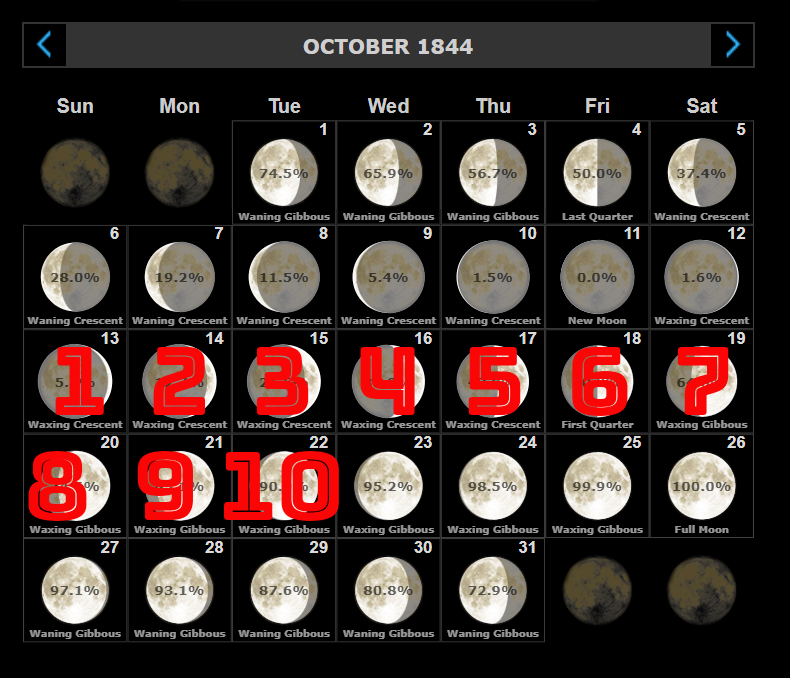
Remember, the astronomical new moon fell on October 11th. However, the first slither wasn't seen until the evening of the 12th. Because the evening of the 12th is Biblically the 13th, we count October 13th as the first day of Tishri or the first day of the seventh Jewish month. Counting ten days from that date brings us to October 22.
However, critics have even found issues with how we numbered the days of this month. Let's look at both allegations below:
Allegations against the Adventist view of October 1844's new moon



Allegation 1. Even if the Day of Atonement fell in October of1844, the crescent moon that occurred on the 12th was too small to be seen.
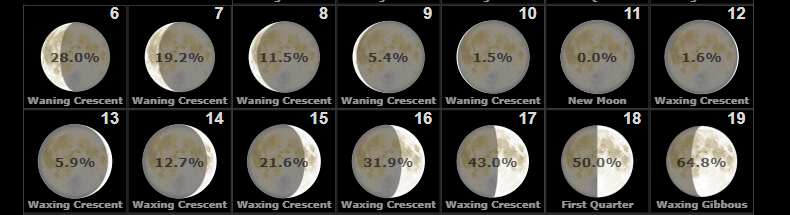
If you look closely at the calendar taken from moongiant.com, they give us the percentage of the moon that was visible for each phase. You should see that the new crescent moon on October 12th was only a 1.6% slither. As a result, the critic says that a slither that small cannot be seen with the naked eye. Therefore, the Jewish observer would not have counted that evening as the first day of Tishri; he would've taken the new moon that showed on the following evening. Taking the 14th of October as Tishri 1 results in October 23 as the first day of the tenth month.
Thus, the critic says that even if October was the correct month, the day we chose would've still been wrong.
Allegation 2: A new moon cannot be seen during twilight
Critics have also discovered that on the evening of October 12, the sunset, twilight, and moonset combination would also have prohibited the observer from seeing the new moon that evening. Let's look at the screenshot below of that day's observations:
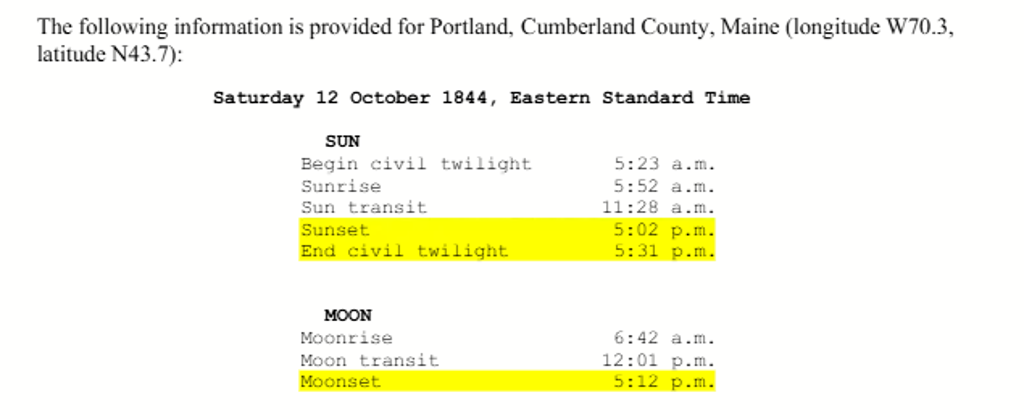
I have highlighted the necessary observed times. As you can see the sunset on October 12, 1844, was at 5:02 pm. Then the moon set below the horizon at 5:12 pm. This means that the observer would have only had approximately 10 minutes to see the small crescent moon on October 12th. To make matters worse, we see that the twilight shows that the sky was still illuminated, and that illumination lasted after the moon had set. This suggests that the twilight would've drowned out any chance for the observer to see the crescent moon, and he would not have counted that night as the beginning of the month.
Answering the allegations
To summarize both allegations into one complete thought, we could say that the observer in Jerusalem in 1844 would not only have had a difficult time seeing a one percent crescent moon, but he would've had an even harder time seeing a one percent crescent moon in twilight hours; therefore, the observer would have waited until the next evening.
On its face, these allegations appear solid. And to be honest, they would be solid...if there was actually a sanctuary in Jerusalem in 1844. What I mean is that because we are under the New Covenant, the types and shadows of the feast days are no longer relevant. We are not looking at the typical sanctuary by the antitypical Sanctuary. Thus, we are not dependent on human observations to determine when God should begin to cleanse His Sanctuary. The question is not if the observer would've seen the crescent, but whether the crescent was there on October 12th. By every calendar that I've seen, there was a slither that night, thus the new moon was there regardless of human observation. By the definition of a new moon, the month began on October 13th.
However, I do recognize that there may be those who need a little more concrete evidence than just my words. They require something to assure them that a one percent slither can actually be seen during twilight hours with the naked eye. If this is you, please see below:
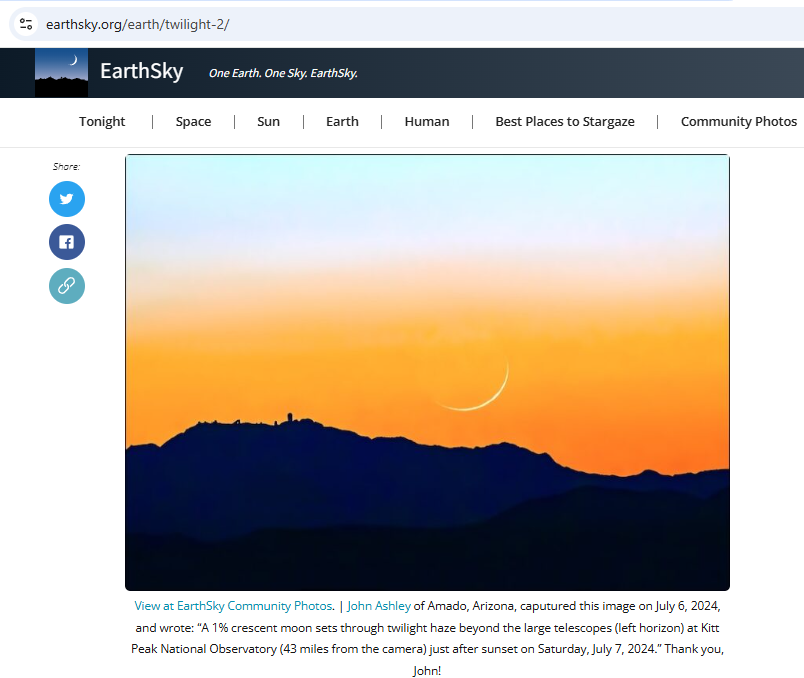
In case the caption is too small, here's what it says: "View at EarthSky Community Photos. | John Ashley of Amado, Arizona, caputured this image on July 6, 2024, and wrote: “A 1% crescent moon sets through twilight haze beyond the large telescopes (left horizon) at Kitt Peak National Observatory (43 miles from the camera) just after sunset on Saturday, July 7, 2024.” Thank you, John!" (https://earthsky.org/earth/twilight-2/)
Notice this user captured a one percent crescent at twilight. Thus, there is no question that the first day of Tishri in the year 1844 fell on October 13th, and the tenth day was October 22nd.