

One of the most important dates in prophetic interpretation is the year that King Artaxerxes issued the decree to restore and rebuild Jerusalem (Ezra 7). For centuries, both Protestant and Adventist scholars have identified this decree as occurring in 457 BC, forming the foundation for calculating the 2300-day prophecy of Daniel 8:14 and its fulfillment in 1844.
However, today, modern scholars argue that the decree actually occurred in 458 BC. If true, this would shift the prophetic timeline and create significant implications for us Adventists, who uphold the 1844 date.
So which year is correct—457 BC or 458 BC?
Let’s carefully examine the historical and biblical evidence.
Why the Debate Exists
The disagreement between 457 BC and 458 BC is a real debate that arises from several complicated historical factors. Let's look at a few of them below:
Multiple Calendar Systems
Ancient Jews used two primary calendars:
- Religious Calendar – Began in the spring (around March/April, the month of Nisan).
- Civil Calendar – Began in the fall (around September/October, the month of Tishri).
In addition, the Jews sometimes adopted elements of foreign calendars depending on who ruled them:
- Egyptian calendar (which floated due to lack of leap years)
- Babylonian calendar (spring-based)
- Persian calendar (also spring-based)
Because many of the ancient documents seemingly reflect different calendar systems, determining exact dates has proven to be challenging at times.
Illegible documents
Due to the age of many of these ancient artifacts, determining historical timelines can be somewhat challenging, as many of the documents found are not always legible. Some documents are partial or pieced together; thus, some of the documents that could possibly answer the 458/ 457 question have generated more questions.
The Case for 458 BC
Not long after the 457 BC date was used to determine the 2300-day prophecy, modern scholars began to question the validity of how Adventists reckoned the prophecy, due to the growing sentiment that favored a 458 BC date for the decree.
Those who determined Artaxerxes' seventh year was 458 BC arrived at that conclusion from a Babylonian astronomical tablet that revealed Xerxes (Artaxerxes father) died in August of 465 BC.





Xerxes’ Death
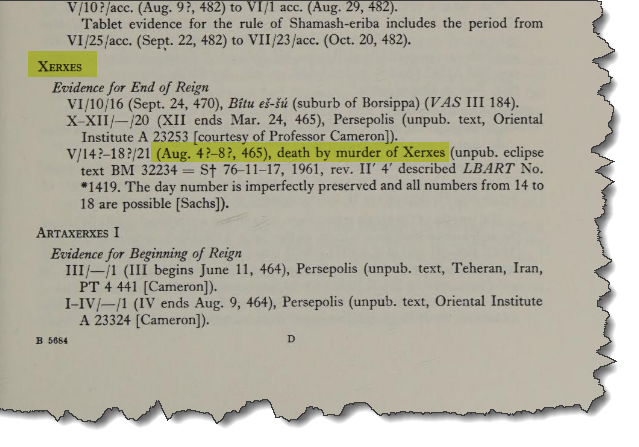
According to the above screenshot from the Babylonian Chronology 626 BC-AD 75, p. 17, the astronomical tablets and Babylonian records reveal that Xerxes died in August 465 BC. If Artaxerxes immediately began ruling, then counting his reign from that point:
- His first year would begin in 465 BC.
- His seventh year would fall between 459–458 BC.
- Therefore, Ezra’s departure in the spring would occur in 458 BC.
However, what you must know is that the kings of the ancient world didn't always count the years of their rulers in a straightforward manner.
ACCESSION YEAR SYSTEMS:
Ancient Near Eastern kingdoms often used an accession-year system.
Under this system:
- When a king came to the throne mid-year, that partial year was called his accession year.
- His official “first year” began at the start of the next new year.
The best way that I can explain this is an engagement and a marriage: When I proposed to my girlfriend (now wife), we were engaged for around six months. Although we were together, our marriage year count only began after the wedding. Similarly, in an accession-year system, the king's accession was like an engagement. Although he officially ruled as king, his first regnal year (marriage) didn't begin until the start of the new year.
However, even utilizing the accession rules, Artaxerxes 7th year would still be 458 BC. (see below)
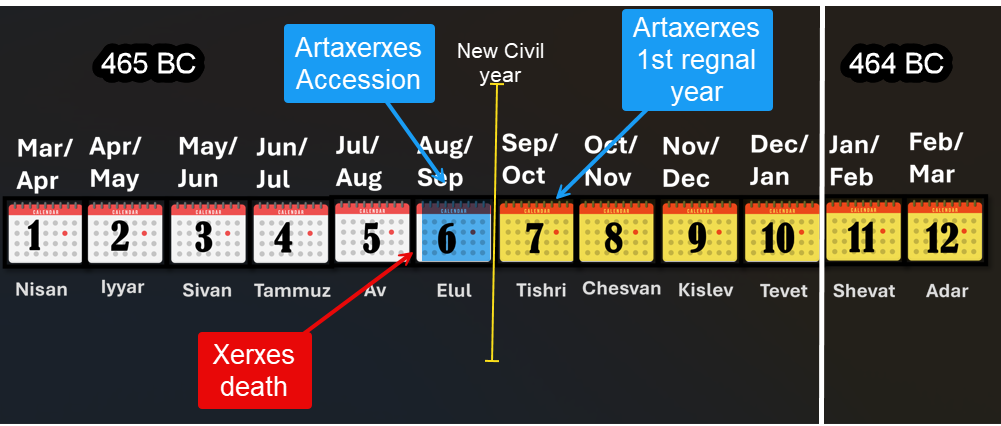
Explanation: Because Xerxes died in August of 465 BC, it is believed that Artaxerxes would've begun ruling immediately. His accession year would've been around a month and a half (Aug to Sept/Oct), and the new civil year would've begun his first regnal year. Thus, even utilizing the accession system, Artaxerxes 7th year would still fall between 459 BC and 458 BC. With the evidence we have thus far, it is easy to understand why most modern scholars believe Artaxerxes' seventh year was 458 BC.
EVIDENCE SUPPORTING 457 BC
Now we examine why many legacy Protestant and Adventist scholars conclude that the decree occurred in 457 BC.
1. THE ELEPHANTINE PAPYRI
Aramaic papyri discovered at Elephantine in Egypt contain double-dated documents (using both Egyptian and Jewish systems). Here's what the document (also known as AP-6) said, according to The Chronology of Ezra 7:

Scholars who have examined the above quotation realize that the "beginning of his reign" part of the quote refers to an accession. However, they also realized that the 21st year could not have related to Artaxerxes as it was the "beginning of the reign." Thus, the 21st year was a reference to his father, Xerxes.
Thus, scholars who have calculated and harmonized the two dates (Jewish and Egyptian) given on this Papyrus determined that around January 2/3, 464 BC, Artaxerxes was in his accession year. If this is the case, then that means Artaxerxes official first regnal year would begin in the fall (Tishri) of 464 BC, and his seventh year would have been 457 BC.
2. PTOLEMY’S CANON
The 2nd-century astronomer Claudius Ptolemy compiled a king's list known as the Canon of Kings.
His data—based on astronomical observations—places Artaxerxes’ accession in late 465 BC, aligning with the idea that his official regnal year began in 464 BC.
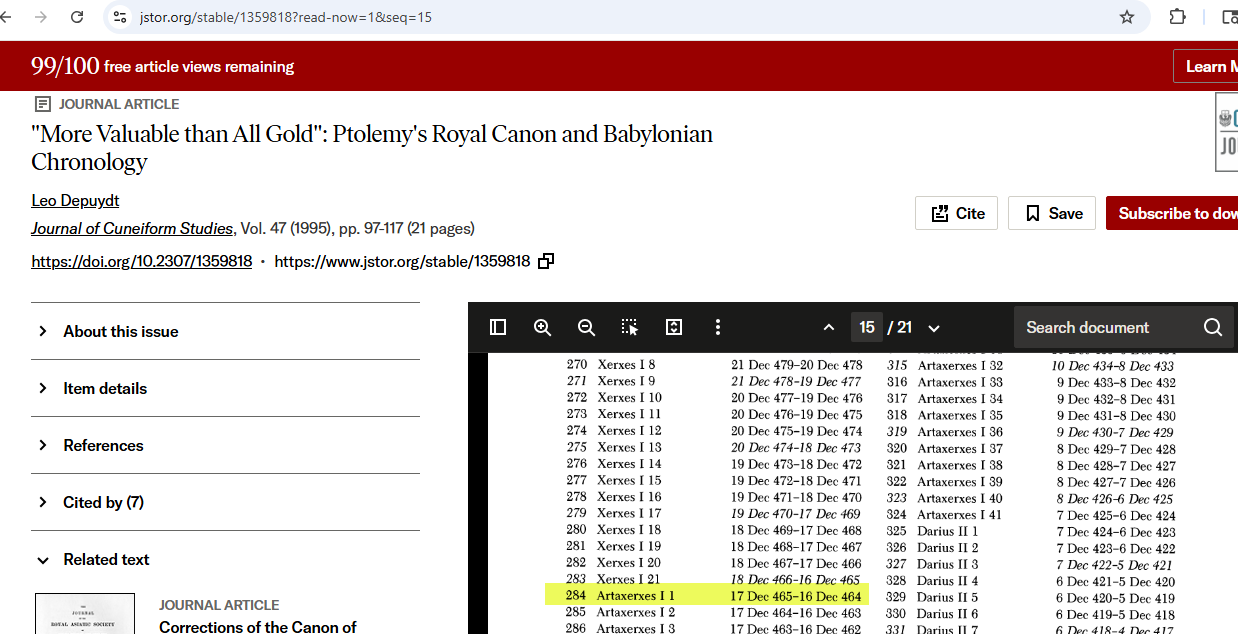
As you can see from the highlighted portion of the document, Ptolemy's historical document placed Artaxerxes accession period in December of 464. A few weeks earlier than AP-6, however, we still can safely assume that if Artaxerxes was in his accession period in December or January of 464, his first regnal year would have begun in 464 BC, and his seventh regnal year would have fallen in 457 BC.
Harmonizing a possible contradiction
So we see two timelines. One timeline shows Xerxes dying in August 465 BC, a month or so before the new year; the other timeline shows Artaxerxes still in his accession year, months after the civil year began. So now we recognize there appears to be conflicting information with the historical record...or is there?
As students of the Bible, whenever we have two seemingly contradicting facts, instead of choosing one over the other, we first must determine if they can be harmonized. And when we look at the historical record, we can determine what occurred after Xerxes died.
According to the Encyclopaedia Britannica, a court official by the name of Artabanus schemed to obtain the throne of the Persian Empire. According to the historical record, after he assassinated Xerxes, he "was in control of the Achaemenid state for seven months and was recognized as king by Egypt." A study published in the Harvard University journal literature also discusses this delayed accession instigated by the court official.
We also must recognize that Artaxerxes was not the crown prince. He had two older brothers. Darius was in line for the throne, and Hystapses, his other brother, governed a province known as Bactria. History reveals that Artaxerxes killed Darius after being manipulated by Artabanus. However, after he realized Artabanus was manipulating him, he then killed Artabanus. Not long after, Hystapses revolted and was defeated by Artaxerxes.
Taking into account that Artaxerxes had to remove the threat of succession by his two older brothers and the Artabanus manipulation, we can see how multiple sources would place Artaxerxes' accession period well past the civil new year in 465.
Conclusion
After weighing both sides carefully, the preponderance of historical and biblical evidence supports the traditional conclusion: Artaxerxes ascended the throne sometime during or after the conflict with his brothers and the "rulership" of Artabanus. Thus, his first regnal year began in the fall of 464 BC, and we can confidently confirm that the decree to restore and rebuild Jerusalem went forth in the spring of 457 BC.