
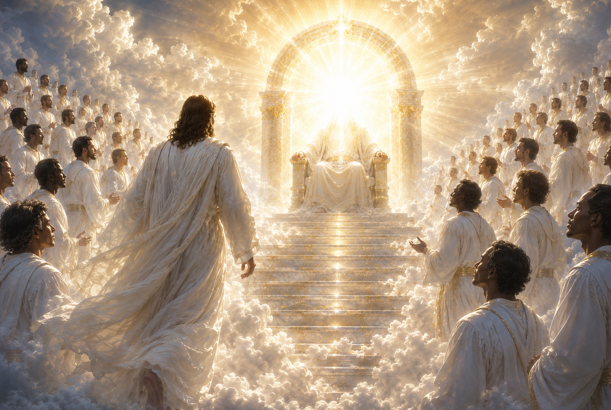
Many Christians read Daniel chapter 7 and conclude that the “Son of man” coming before the “Ancient of Days” is simply a picture of Christ’s ascension after His resurrection. But does the chapter itself actually support that interpretation?
A closer study of the structure and flow of Daniel 7 suggests something deeper is taking place — a heavenly judgment scene where Christ is brought to His Father. As Adventists, we call this the Investigative Judgment.
What Is the Investigative Judgment?
Among Seventh-day Adventist Church believers, this heavenly phase of judgment is often called the “Investigative Judgment.” While that phrase itself is not found in Scripture, it is used to distinguish the investigative phase of judgment from the execution phase described later in the book of Revelation.
The concept is simple:
- God opens the records.
- The judgment is revealed before the universe.
- The determination of who belongs to Christ is made openly and justly.
This does not mean God has lost His omniscience. Scripture consistently presents God as allowing His judgments to be seen and understood. From Eden to Abraham’s test on Mount Moriah, God demonstrates His fairness publicly.
A Courtroom Before the Sentence
Many Christians think only of the “White Throne Judgment” at the end of time. But what they may not realize is that every courtroom has a process before sentencing:
- evidence is examined,
- witnesses are heard,
- decisions are reached.
Likewise, Scripture presents a heavenly process before God renders His judgment.
According to the Bible, when Jesus comes in the clouds, destinies have already been decided. Revelation 22:11 says,
"He that is unjust, let him be unjust still: and he which is filthy, let him be filthy still: and he that is righteous, let him be righteous still: and he that is holy, let him be holy still. And, behold, I come quickly; and my reward is with me, to give every man according as his work shall be."
Thus, when Christ returns, He will not have to decide who the sheep and goats are— their status will have already been determined when Christ returns. In this manner, you must see that the Investigative Judgment is not a second judgment, but a phase within the one final judgment of God.
Is Daniel 7 About the Ascension?
I saw in the night visions, and, behold, one like the Son of man came with the clouds of heaven, and came to the Ancient of days, and they brought him near before him. Daniel 7:13
Many churches interpret Daniel 7:13 as the event that occurred with Christ once He ascended to heaven after His resurrection. At first glance, this seems reasonable because Acts 1:9 tells us that "he was taken up; and a cloud received him out of their sight." Thus, logic seems to dictate that the cloud Christ was taken up with then took him to the Ancient of Days. While this is a plausible interpretation for what we are seeing in Daniel 7, there is a major problem with that interpretation.
Daniel 7 says Christ comes before the Father to receive:
- a kingdom,
- dominion,
- and authority.
However, according to Jesus' own words, He received “all power” after His resurrection (Matthew 28:18). According to the Scriptures, the complete transfer of the kingdoms of this world occurs with the sounding of the seventh trumpet. Notice what the Bible says:
And the seventh angel sounded; and there were great voices in heaven, saying, The kingdoms of this world are become the kingdoms of our Lord, and of his Christ; and he shall reign for ever and ever. Revelation 11:15
Most understand that this event is still future; thus, it is unlikely that Daniel 7:13 is describing the ascension.
Is It the Second Coming?
If the scene is not the ascension, could it be the Second Coming?
The difficulty there is that at Christ’s return, He is already seated at the Father’s right hand. According to Mark 14:62, when Jesus comes, He is already "sitting on the right hand of power."
A prophetic Dichotomy
At this point, it probably feels like we've come to a proverbial fork in the road:
The coming of the Son of Man before the Ancient of Days must occur:
- after the ascension,
- but before the Second Coming.
It appears like a dichotomy. However, the structure of Daniel reveals what is happening.
The Key to Understanding Daniel 7
I want you to see the symbiotic relationship between Daniel's visions and their interpretations.
In Daniel, you will notice that:
- the vision and interpretation always match,
- the vision never introduces symbols absent from the interpretation,
- and the meaning stays within the framework already established.
This pattern appears in:
- Daniel 2, with Nebuchadnezzar's dream
- Daniel 7, with the four Beasts
- and Daniel 8 with the horned animals.
The interpretation always mirrors the vision itself. Please keep this understanding in mind as you view the graph below of Daniel 7:
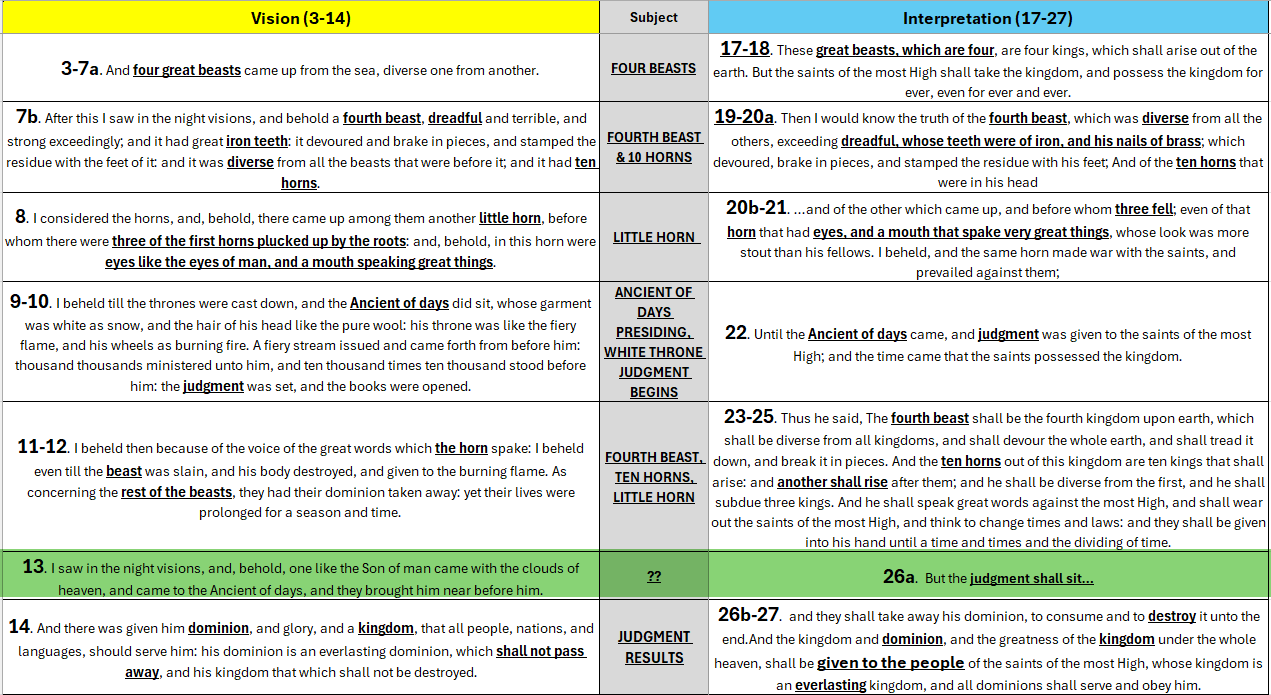
Looking at the correlation of the vision and the interpretation, we can see that when Jesus came to the Ancient of Days, it could not have been the resurrection or the Second Coming—it had to be related to the judgment. While it is possible that there is some event that occurs during the White Throne Judgment where Jesus separates from His Father and then is brought back to him, I believe the context of Christ coming to His Father in relation to the judgment was seen in one of Ellen G. White's visions. Here's what she said:
And I saw the Father rise from the throne, and in a flaming Chariot go into the Holy of Holies, within the veil, and did sit There I saw thrones that I had never seen before. Then Jesus rose up from the throne, and the most of those who were bowed down arose with Him; and I did not see one ray of light pass from Jesus to the careless multitude after he arose, and they were left to perfect darkness. Those who rose up when Jesus did, kept their eyes fixed on Him as He left the throne and led them out a little way.—Then He raised His right arm and we heard his lovely voice saying, “Wait here—I am going to my Father to receive the Kingdom; keep your garments spotless, and in a little while I will return from the wedding and receive you to myself.” And I saw a cloudy chariot, with wheels like flaming fire, and Angels were all around it as it came where Jesus was. He stepped into the chariot and was borne to the Holiest where the Father sat. —Ellen G White, the Shut Door Question p. 24
According to Ellen White, Jesus and the Father were both in the Holy Place prior to 1844. It wasn't until the close of the 2300-days that God went to the Most Holy Place, and Jesus followed Him.
The Ancient of Days then the Son of Man
Notice, verse 9 begins by saying, "I beheld till the thrones were cast down, and the Ancient of days did sit..." Examining Daniel 7, we see that when the Ancient of Days is introduced to the vision, He is not mentioned with the Son of Man. Thus, all indications reveal that He sat by Himself.
Then, we see the clouds of heaven "brought him [Son of Man] near before him."
It appears that in Ellen White's vision, when she saw "the Father rise from the throne, and in a flaming Chariot go into the Holy of Holies" and Jesus, who then "stepped into the chariot and was borne to the Holiest where the Father sat," matches the description given by the prophet Daniel.
In this manner, when the Father sat, and Jesus came to Him, this was the scene that occurred in heaven which marked the beginning of the Investigative Judgment on October 22, 1844.
The Beginning and End of Judgment
Daniel 7 cannot just be about the Investigative Judgment. We know this because vs. 10 ends by saying, "the judgment was set, and the books were opened." This idea of books being opened is undeniably linked to the White Throne Judgment that happens at the end of the world:
And I saw the dead, small and great, stand before God; and the books were opened... Revelation 20:12
This, Daniel 7 appears to blend together both the Investigative phase and the White Throne phase together. It's a flash back and a flash forward.
My analysis of Daniel 7, is that there are three of these flash back - flash forward moments. Let's highlight them below:
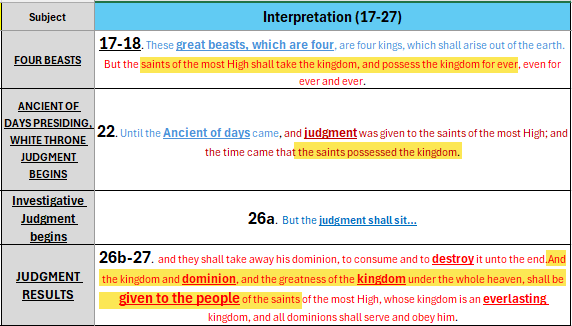
The yellow-highlighted portions refer to the end result. Notice in verses 17-18, the text begins about the four beasts but ends with the saints possessing the kingdom. In essence, it blends their beginning and ending. I believe this pattern continues throughout the chapter. Thus, in verse 22, when the Ancient of Days came, that was the beginning, and it resulted in the saints possessing the kingdom.
In like manner, I also believe this same pattern plays out in verses 26-27. Notice the scene begins with the judgment sitting (Investigative), but ends in the kingdom being given to the people (possession).
There Is Nothing to Fear
The final message of this interpretation is one of hope, not fear.
If Christ is both Savior and Judge, then believers do not need to fear judgment. Scripture calls Jesus a “righteous judge” in 2 Timothy 4:8.
The judgment is not about believers standing alone before God. It is about Christ standing on behalf of His people.
Daniel 7 ultimately points to a victorious kingdom:
- Christ receives dominion,
- the saints inherit the kingdom,
- and evil is finally destroyed.
For believers, the judgment is not merely a warning — it is the assurance that God’s justice and mercy will prevail.